


REITs Offer Income and Diversification

Real estate investment trusts (REITs) can offer a consistent income stream and help provide portfolio diversification.
If you own broad stock funds, it's likely that you have some exposure to REITs, perhaps without being aware of it — about 85% of general equity funds contain REITs.1 For a more strategic approach to making REITs a part of your investment portfolio, you can buy shares in a variety of REIT funds or individual publicly traded REITs.
Pooled property investments
An equity REIT (the most common type of REIT) is a company that uses the combined capital of a large number of investors to buy and manage residential, commercial, or industrial income properties. Equity REITs typically focus on a specific type of property that might range from shopping malls, apartment buildings, and medical facilities to self-storage facilities, hotels, and cell towers.
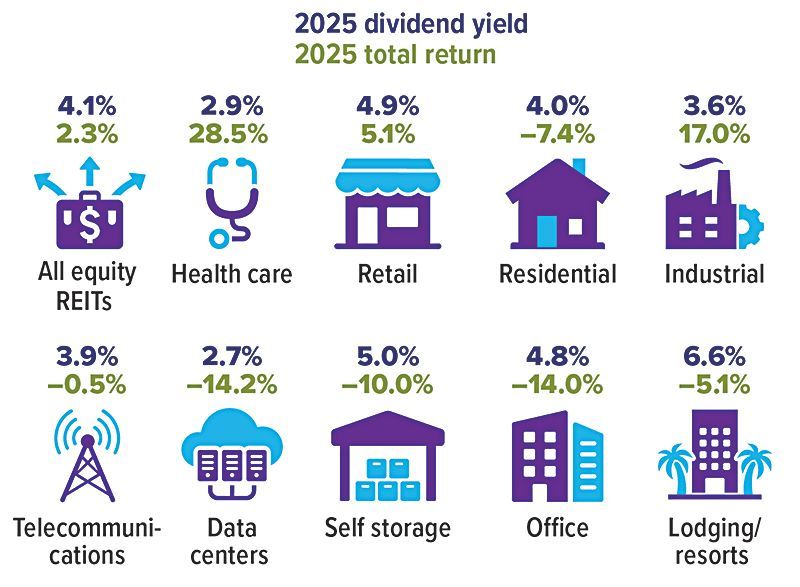
Under the federal tax code, a qualified REIT must pay at least 90% of its taxable income each year in the form of shareholder distributions. Unlike many companies, REITs generally do not retain earnings, so they may provide higher distribution percentages than some other investments. At the end of 2025, equity REITs paid an average dividend of 4.1%, almost triple the 1.4% average of dividend-paying stocks in the S&P 500 Index.2-3 REIT dividends may be similar to bond yields in a high interest-rate environment and higher than bond yields in a lower-rate environment.
Share price volatility
While equity REITs are effective income-generating assets regardless of interest rates, share prices can be volatile and are especially sensitive to higher rates. Companies often depend on debt to acquire rent-producing properties, and REIT dividends may appear less appealing to investors relative to the stability of bonds offering similar yields. REIT share prices struggled in the high interest-rate environment of 2022 to 2025 and may be poised for better share-price performance as rates decline.4 For buy-and-hold investors, however, the income from REIT dividends might be more important than short-term movements in share prices.
Diversification and asset allocation
Along with providing income, REITs can help increase diversification and broaden asset allocation, because REIT shares do not always follow the movements of stocks or bonds. Over the 10-year period ending in 2025, equity REITs had a correlation of 78% with the S&P 500 and 57% with the corporate and government bond market.5 As this suggests, REITs are in some respects a unique asset class.
Diversification and asset allocation do not guarantee a profit or protect against investment loss.
Real estate risks
There are inherent risks associated with real estate investments and the real estate industry that could adversely affect the financial performance and value of a real estate investment. Some of these risks include a deterioration in national, regional, and local economies; tenant defaults; local real estate conditions, such as an oversupply of, or a reduction in demand for, rental space; property mismanagement; and changes in operating costs and expenses, including increasing insurance costs, energy prices, real estate taxes, and the costs of compliance with laws, regulations, and government policies.
The return and principal value of all investments fluctuate with changes in market conditions. Shares, when sold, may be worth more or less than their original cost. REIT distributions are not guaranteed. Investments seeking to achieve higher yields also involve a higher degree of risk.
Funds are sold by prospectus. Please consider the investment objectives, risks, charges, and expenses carefully before investing. The prospectus, which contains this and other information about the investment company, can be obtained from your financial professional. Be sure to read the prospectus carefully before deciding whether to invest.
(1–2, 4–5) Nareit, 2024–2026
(3) S&P Dow Jones Indices, December 31, 2025
All Securities Through Money Concepts Capital Corp., Member FINRA / SIPC
11440 North Jog Road, Palm Beach Gardens, FL 33418 Phone: 561.472.2000
Copyright 2010 Money Concepts International Inc.
Investments are not FDIC or NCUA Insured
May Lose Value - No Bank or Credit Union Guarantee
This communication is strictly intended for individuals residing in the state(s) of MI. No offers may be made or accepted from any resident outside the specific states referenced.
Prepared by Broadridge Advisor Solutions Copyright 2020.