



What Is Value Investing?

During the period before and after World War II, financial analyst and Columbia University professor Benjamin Graham published two books, Security Analysis (1934) and The Intelligent Investor (1949), that defined an approach to the stock market that became known as value investing.
Although some of Graham's ideas have become outdated, his basic strategy remains a bedrock of modern investing, and his most famous pupil, Warren Buffett, is considered among the greatest investors of all time.
Put simply, Graham's strategy was to analyze the underlying value of a company in relation to its share price and only buy shares of companies that he considered significantly undervalued. He believed that this not only provided growth potential but also what he called a "margin of safety" to help mitigate loss — i.e., he found that undervalued but otherwise healthy companies were less likely to have further large declines in stock prices.1
Becoming a business owner
At the heart of this strategy is viewing the purchase of stock shares as becoming a part owner of a company. "A stock is not just a ticker symbol or an electronic blip," Graham wrote, "it is an ownership interest in an actual business, with an underlying value that does not depend on its share price."2 Graham viewed market downturns as an opportunity to buy shares at better values and market upswings as a time to sell stocks that had become overvalued.
Properly evaluating a company requires substantial work and expertise, examining metrics such as earnings per share, the price-earnings ratio (share price/12 months of earnings), and the price-book ratio (share price/net value of company), as well as the company's operations, market position, leadership, and more. Nonprofessional investors may be unable or unwilling to put in this kind of effort to evaluate individual stocks. However, there are many funds that focus on "value stocks," while others may focus on "growth stocks," which tend to be more expensive in relation to their underlying value but may have more potential for future growth.
Shifting styles?
Although the principles of value investing are timeless, modern analysts point out that Graham underestimated the growth potential of some stocks that might seem overvalued. This has proven to be true over the last 20 years as large technology companies have experienced rapid growth despite being overvalued by traditional analysis. It's impossible to know whether or not this will continue, but there was a notable shift from growth to value in late 2025 and early 2026 that some analysts believe could mark a longer-term trend.3
Performance Over Time
The last 20 years have been a strong period for growth stocks, but value stocks outperformed in earlier periods. Annual returns have varied widely.
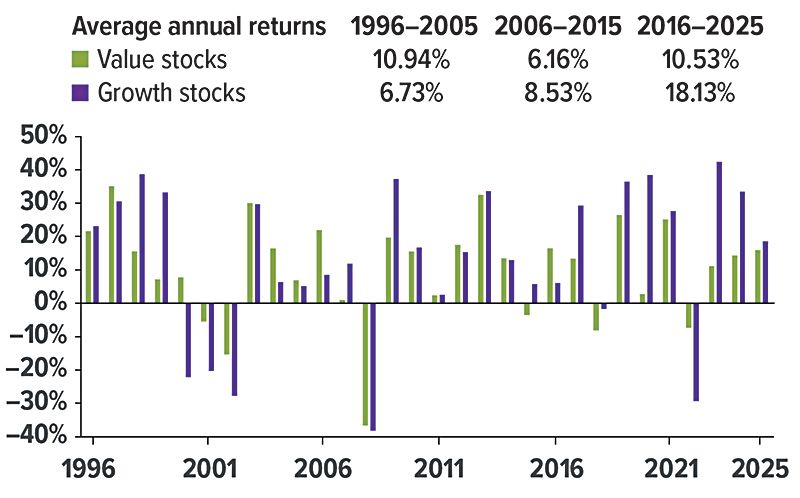
Because value and growth stocks tend to perform differently under different market conditions, it may be wise to hold both types of stocks in your portfolio, which can be accomplished by investing in broad index funds. If you want to weight your portfolio toward a value or growth strategy (often called an investing style), you might add a value or growth fund or individual stocks selected for value or growth. Definitions of value and growth stocks differ among funds and may change over time within the same fund, so it's important to understand a fund's objectives and structure.
There is no guarantee that any investment strategy will be successful. The return and principal value of stocks and stock funds fluctuate with changes in market conditions. Shares, when sold, may be worth more or less than their original cost.
Funds are sold by prospectus. Please consider the investment objectives, risks, charges, and expenses carefully before investing. The prospectus, which contains this and other information about the investment company, can be obtained from your financial professional. Be sure to read the prospectus carefully before deciding whether to invest.
(1) Investopedia, November 21, 2024
(2) Goodreads, 2026
(3) Bloomberg, February 4, 2026
All Securities Through Money Concepts Capital Corp., Member FINRA / SIPC
11440 North Jog Road, Palm Beach Gardens, FL 33418 Phone: 561.472.2000
Copyright 2010 Money Concepts International Inc.
Investments are not FDIC or NCUA Insured
May Lose Value - No Bank or Credit Union Guarantee
This communication is strictly intended for individuals residing in the state(s) of MI. No offers may be made or accepted from any resident outside the specific states referenced.
Prepared by Broadridge Advisor Solutions Copyright 2020.