
Key Retirement and Tax Numbers for 2022

Every year, the Internal Revenue Service announces cost-of-living adjustments that affect contribution limits for retirement plans and various tax deduction, exclusion, exemption, and threshold amounts. Here are a few of the key adjustments for 2022.
Estate, Gift, and Generation-Skipping Transfer Tax
- The annual gift tax exclusion (and annual generation-skipping transfer tax exclusion) for 2022 is $16,000, up from $15,000 in 2021.
- The gift and estate tax basic exclusion amount (and generation-skipping transfer tax exemption) for 2022 is $12,060,000, up from $11,700,000 in 2021.
Standard Deduction
Taxpayers can generally choose to itemize certain deductions or claim a standard deduction on their federal income tax returns. In 2022, the standard deduction is:
- $12,950 (up from $12,550 in 2021) for single filers or married individuals filing separate returns
- $25,900 (up from $25,100 in 2021) for married joint filers
- $19,400 (up from $18,800 in 2021) for heads of household
The additional standard deduction amount for the blind and those age 65 or older in 2022 is:
- $1,750 (up from $1,700 in 2021) for single filers and heads of household
- $1,400 (up from $1,350 in 2021) for all other filing statuses
Special rules apply for those who can be claimed as a dependent by another taxpayer.
IRAs
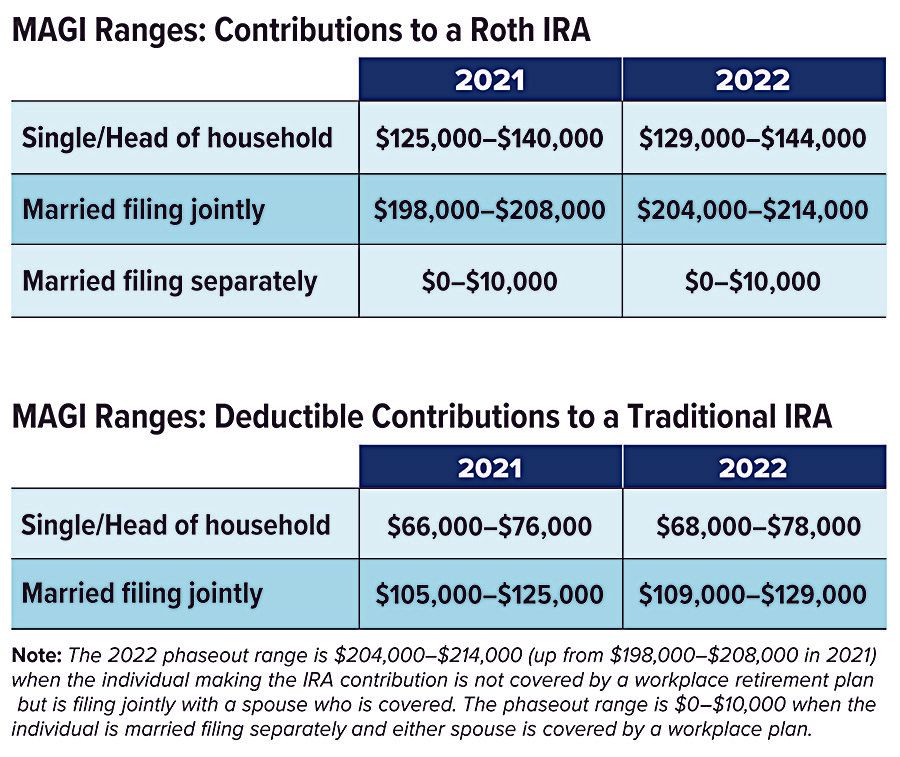
The combined annual limit on contributions to traditional and Roth IRAs is $6,000 in 2022 (the same as in 2021), with individuals age 50 or older able to contribute an additional $1,000. The limit on contributions to a Roth IRA phases out for certain modified adjusted gross income (MAGI) ranges (see chart). For individuals who are covered by a workplace retirement plan, the deduction for contributions to a traditional IRA also phases out for certain MAGI ranges (see chart). The limit on nondeductible contributions to a traditional IRA is not subject to phaseout based on MAGI.
Employer Retirement Plans
- Employees who participate in 401(k), 403(b), and most 457 plans can defer up to $20,500 in compensation in 2022 (up from $19,500 in 2021); employees age 50 or older can defer up to an additional $6,500 in 2022 (the same as in 2021).
- Employees participating in a SIMPLE retirement plan can defer up to $14,000 in 2022 (up from $13,500 in 2021), and employees age 50 or older can defer up to an additional $3,000 in 2022 (the same as in 2021).
Kiddie Tax: Child's Unearned Income
Under the kiddie tax, a child's unearned income above $2,300 in 2022 (up from $2,200 in 2021) is taxed using the parents' tax rates.
All Securities Through Money Concepts Capital Corp., Member FINRA / SIPC
11440 North Jog Road, Palm Beach Gardens, FL 33418 Phone: 561.472.2000
Copyright 2010 Money Concepts International Inc.
Investments are not FDIC or NCUA Insured
May Lose Value - No Bank or Credit Union Guarantee
This communication is strictly intended for individuals residing in the state(s) of MI. No offers may be made or accepted from any resident outside the specific states referenced.
Prepared by Broadridge Advisor Solutions Copyright 2020.