
Index Funds: Traditional and Not-So-Traditional

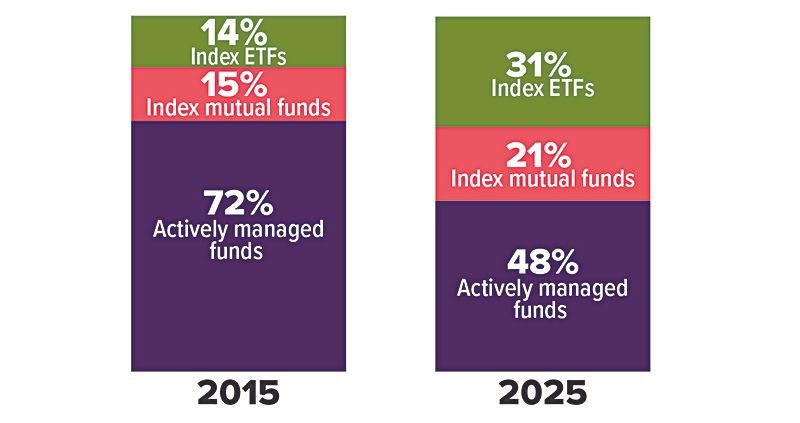
Index funds accounted for more than half of long-term fund assets in 2025 (see chart).
These funds attempt to track the performance of a market index by holding all or a representative sample of the securities in the index. Many funds follow well-known indexes such as the S&P 500, Russell 2000, or NASDAQ Composite. But there are hundreds of other indexes that track various segments of the stock and bond markets.
This approach is called passive management and typically allows index funds to carry lower fees than comparable funds under active management, where the fund manager picks securities to meet an objective and might buy or sell as conditions change. Lower turnover of securities in index funds also may reduce capital gain distributions, which could help reduce tax liabilities and improve after-tax performance.
Watch the weight
Traditional index funds provide exposure to the market or selected portions of the market and can be helpful in establishing and maintaining an appropriate asset allocation and diversification strategy. However, most indexes followed by traditional funds are weighted based on market capitalization — the value of a company's underlying shares. So the largest companies tend to dominate the index and the fund.
For example, in the summer of 2026, the top 10 stocks in the S&P 500 Index accounted for more than 35% of its market capitalization.1 If you own an S&P 500 Index fund, you may be more heavily invested in those 10 companies than you realize. That is not necessarily negative — the largest companies often become large because they are successful — but it is something to be aware of in analyzing your portfolio.
Alternative approaches
An alternative indexing strategy — called smart beta, strategic beta, or factor-based investing — tracks indexes that are selected and weighted based on factors other than market segment or capitalization. Some factors that might be considered include momentum, risk, volatility, earnings, growth potential, price-to-book value, dividend growth or yield, cash flow, and equal weighting of all securities. Smart-beta funds may focus on a single factor or multiple factors, and a given fund might track an existing index or an index that is newly created for that specific fund.
Another alternative approach — called quantitative investing or quant funds — constructs an index and fund based on sophisticated computer models using quantitative analysis, algorithms, or machine learning.
These alternative approaches are similar to the kind of analysis an active investment manager might use in constructing a fund, but because they use a passive indexing approach, they typically have the lower fees and potential tax efficiency of an index fund.
Factors are not forever
The goal of most smart-beta and quant funds is to outperform the broader market, either by increasing returns or by managing risk. But if a factor or quantitative analysis does outperform during one market cycle, it may underperform in the next cycle, and even within a given cycle, a successful strategy might become neutralized or unsuccessful.
Therefore, smart-beta and quant funds are typically used with traditional broad-based market funds in a diversified portfolio. Be sure you understand the structure and objectives of any fund before investing.
Asset allocation and diversification do not guarantee a profit or protect against investment loss. The principal value of funds will fluctuate with changes in market conditions. Shares, when sold, may be worth more or less than their original cost. Bond funds are subject to the same inflation, interest-rate, and credit risks associated with their underlying bonds. As interest rates rise, bond prices typically fall, which can adversely affect a bond fund's performance.
The S&P 500 is generally considered to be representative of the U.S. stock market. The performance of an unmanaged index is not indicative of the performance of any specific investment. Individuals cannot invest directly in an index. Actual results will vary.
Funds are sold by prospectus. Please consider the investment objectives, risks, charges, and expenses carefully before investing. The prospectus, which contains this and other information about the investment company, can be obtained from your financial professional. Be sure to read the prospectus carefully before deciding whether to invest.
(1) S&P Dow Jones Indices, 2026
All Securities Through Money Concepts Capital Corp., Member FINRA / SIPC
11440 North Jog Road, Palm Beach Gardens, FL 33418 Phone: 561.472.2000
Copyright 2010 Money Concepts International Inc.
Investments are not FDIC or NCUA Insured
May Lose Value - No Bank or Credit Union Guarantee
This communication is strictly intended for individuals residing in the state(s) of MI. No offers may be made or accepted from any resident outside the specific states referenced.
Prepared by Broadridge Advisor Solutions Copyright 2020.