
What's in Your 401(k)?

Almost 70 million Americans contribute to a 401(k) plan, and millions more contribute to similar workplace plans, such as a 403(b), 457(b), or federal Thrift Saving Plan.
Together, these plans held an estimated $14.2 trillion in assets at the end of 2025.1
Contributing to a 401(k) can be a big step toward a more comfortable retirement. But it's important to understand what you are getting for your money.
Filling the envelope
A 401(k) is not an investment in itself. It is more like an envelope that holds investments under tax-advantaged rules. These plans usually offer a variety of funds as investment options, typically including domestic stock funds, international stock funds, domestic bond funds, and target-date funds — the most common investment, held by seven out of 10 401(k) participants.2
A simple approach
Target-date funds are often the default option in workplace plans, so you may have one without fully understanding what it is. These are "all-in-one" funds intended to be your only investment. They generally hold a mix of other funds containing stocks, bonds, and cash alternatives, selected for a time horizon — the target date — when an investor expects to retire or need access to the money. As the target date approaches, the fund typically shifts toward a more conservative asset allocation to help preserve the value it may have accumulated and potentially provide income.
These funds offer a simple approach to investing, but the allocation is based solely on the target date and does not take into account the investor's risk tolerance, personal goals, asset levels, sources of income, or any other factors that make an investor unique.
The principal value of a target-date fund is not guaranteed before, on, or after the target date. The return and principal value of these funds fluctuates with changes in market conditions. Shares, when sold, may be worth more or less than their original cost.
Choosing your own investments
The average 401(k) offers almost 30 different funds, so there are usually plenty of options for an investor who wants to take a more customized approach and spread investments among a variety of funds.3 With this approach, you can create your own asset allocation and diversification strategy by directing your contributions to the funds you choose in the percentages you choose.
If you take this approach, it's important to understand the goals and underlying holdings of any fund you choose. You may want to check your portfolio's allocation periodically to see if it remains close to your targeted allocation. If you want to adjust your allocation, you could rebalance by buying and selling shares as appropriate and/or by changing the percentages of future contributions. Rebalancing in a 401(k) typically does not create tax consequences.
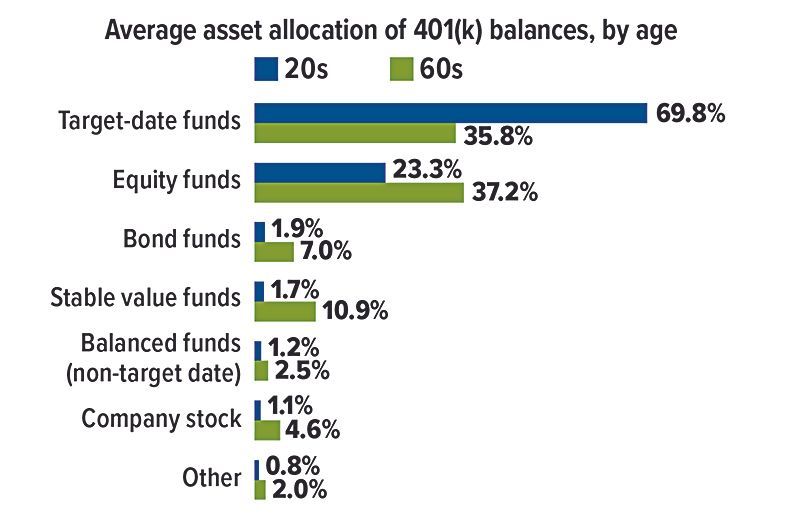
Company stock
Some 401(k) plans also offer company stock as an investment option. This could be worth considering if you believe in your company's future prospects. But it's important to keep any company stock investments in perspective. Becoming overinvested in a single stock, whether it's your company or not, can throw off your strategy and expose you to additional risk.
Whatever investments you choose, know what you are buying and why these investments are appropriate for your situation. If you invest outside of the workplace, it's also important that your 401(k) investments be balanced with your other investments.
Asset allocation and diversification do not guarantee a profit or protect against investment loss. All investing involves risk, including the possible loss of principal, and there is no guarantee that any investment strategy will be successful. Investing internationally carries additional risks such as differences in financial reporting, currency exchange risk, as well as economic and political risk unique to the specific country. This may result in greater share price volatility. Bond funds are subject to the same inflation, interest rate, and credit risks associated with their underlying bonds. As interest rates rise, bond prices typically fall, which can adversely affect a bond fund's performance.
Funds are sold by prospectus. Please consider the investment objectives, risks, charges, and expenses carefully before investing. The prospectus, which contains this and other information about the investment company, can be obtained from your financial professional.
(1-3) Investment Company Institute, 2026
All Securities Through Money Concepts Capital Corp., Member FINRA / SIPC
11440 North Jog Road, Palm Beach Gardens, FL 33418 Phone: 561.472.2000
Copyright 2010 Money Concepts International Inc.
Investments are not FDIC or NCUA Insured
May Lose Value - No Bank or Credit Union Guarantee
This communication is strictly intended for individuals residing in the state(s) of MI. No offers may be made or accepted from any resident outside the specific states referenced.
Prepared by Broadridge Advisor Solutions Copyright 2020.