


HSAs: A Triple-Tax Perk with Short- and Long-Term Benefits

A health savings account (HSA) is one of the most powerful savings and investment vehicles available to individuals and families; however, in order to take advantage of one, you must be enrolled in a qualified high-deductible health plan (HDHP).
According to health policy research organization KFF, about 31% of companies that provide health benefits offered an HSA-eligible HDHP in 2025. In addition, people can purchase HDHPs via a health insurance marketplace.1
While many people view an HSA simply as a way to set aside money for current medical expenses, it can also serve as a valuable retirement-planning tool. Thanks to its unique triple-tax advantage, an HSA offers benefits that few other financial strategies can match.
Understanding the triple-tax advantage
HSAs offer three opportunities to save on taxes:
- Tax-deductible contributions: Contributions made to an HSA are generally tax-deductible, helping reduce taxable income for the year. In many cases, they can be made through payroll deductions, which makes the tax-saving opportunity that much easier.
- Tax-deferred growth: Earnings generated within the account, including interest, dividends, and any potential investment gains, grow on a tax-deferred basis. That means that, unlike a savings or traditional brokerage account, participants don't have to pay taxes on earnings each year.
- Tax-free withdrawals for qualified medical expenses: Qualified withdrawals — i.e., those that pay for eligible health-care expenses — are not subject to federal income tax. Eligible expenses include doctor visits, prescriptions, dental care, vision care, and many other common health-care costs. (See IRS Publication 502 for a list of permissible expenses.)
Note that nonqualified withdrawals prior to age 65 are subject to income taxes and a 20% penalty tax.
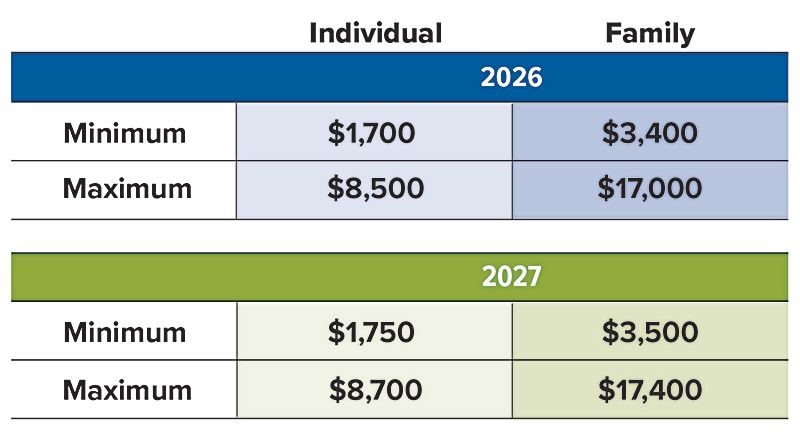
HDHP out-of-pocket deductibles
Long-term wealth-building potential
Participants can also use the account as a reserve fund for future health-care expenses, which tend to increase as a person ages. In fact, once a balance reaches a certain threshold, many HSA providers allow account holders to invest the money. Investment earnings can compound tax deferred over time, potentially creating a substantial pool of assets to help manage future costs.
Participants should consider investment objectives, risks, charges, and expenses associated with available investment options before making any decisions. In addition, there is no guarantee that any investment strategy will be successful.
After age 65, HSA funds can be withdrawn for non-medical purposes without the 20% penalty, although ordinary income taxes will still apply. Essentially, the HSA will be treated like a traditional retirement savings account, providing additional financial flexibility.
Contribution limits
The IRS adjusts HSA contribution limits annually for inflation. For 2026, individuals with self-only HDHP coverage may contribute up to $4,400, while those with family coverage may contribute up to $8,750. Individuals age 55 or older may contribute an additional $1,000 catch-up contribution. For 2027, the limits increase to $4,500 for self-only coverage and $9,000 for family coverage. The $1,000 catch-up contribution remains unchanged for eligible individuals age 55 and older.
A valuable tool for financial wellness
As health-care costs continue to rise, maximizing HSA contributions can be a smart way to help manage both current financial wellness and long-term financial security. For those who qualify, the HSA remains one of the most versatile and tax-efficient accounts available today.
(1) CNBC, May 29, 2026
All Securities Through Money Concepts Capital Corp., Member FINRA / SIPC
11440 North Jog Road, Palm Beach Gardens, FL 33418 Phone: 561.472.2000
Copyright 2010 Money Concepts International Inc.
Investments are not FDIC or NCUA Insured
May Lose Value - No Bank or Credit Union Guarantee
This communication is strictly intended for individuals residing in the state(s) of MI. No offers may be made or accepted from any resident outside the specific states referenced.
Prepared by Broadridge Advisor Solutions Copyright 2020.