
No More Groundhog Day for Your Finances: Time for a Financial Wellness Checkup

Just like Groundhog Day, our financial habits can repeat themselves, month after month and year after year.
That is, until we consciously break the pattern. Now is a good time to check on your finances, since it's still early enough in the year to make meaningful changes. A financial wellness checkup can help you identify patterns that keep you stuck with bad habits and open the door to new behaviors that move you closer to financial stability.
Review your spending and budget
Start out by reviewing your spending over the last month by checking your bank, credit card, and payment app statements. Next, identify what money is coming in, whether earned income or from other sources, such as investments. Add them up and compare the two totals to make sure you are spending within your means. If your expenses outweigh your income, you'll likely need to make some adjustments, such as reducing your discretionary spending.
While it's normal to stray from your budget occasionally, there are some ways to help make working within it a bit easier:
- Make budgeting a part of your daily routine.
- Build occasional rewards into your budget.
- Evaluate your budget regularly and make changes if necessary.
- Use budgeting software/apps to track your progress.
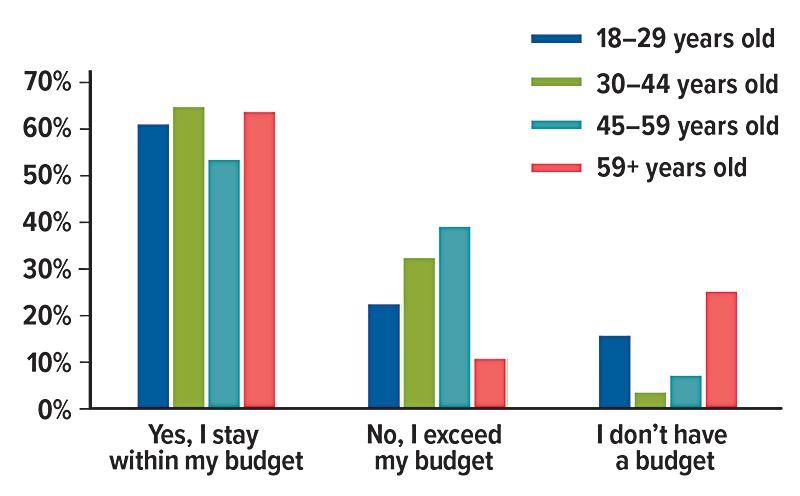
Staying On Budget, by Age Group
Set new financial goals and reprioritize existing ones
Next, take a look at the financial goals you set for yourself — both short- and long-term. Perhaps you wanted to increase your cash reserve or save money for a down payment on a home. Maybe you wanted to invest more money towards your retirement. Did you accomplish any of your goals? Do you have any new goals that you would like to target?
Finally, have your personal or financial circumstances changed during the past year (e.g., marriage, the birth of a child, or a job promotion)? Would that warrant a reprioritization of goals?
Make sure your investment portfolio is still on target
Review your investment portfolio to ensure that it is still on target to help you pursue your financial goals. Ask yourself the following questions:
- Do I still have the same time horizon for investing as I did last year?
- Has my tolerance for risk changed?
- Do I have an increased need for liquidity?
- Does any investment now represent too large (or too small) a part of my portfolio?*
Focus on reducing your debt
An essential part of any financial wellness checkup focuses on reducing debt. Here are some tips to help you keep your debt in check:
- Keep track of all of your credit card balances and be aware of interest rates and hidden fees.
- Develop a plan to manage your payments and strive to avoid late fees.
- Optimize your repayments by paying off high-interest debt first or consider taking advantage of debt consolidation/refinancing programs.
- Avoid charging more than you can pay off at the end of each billing cycle.
Take steps to improve your credit health
Having healthy credit is another important part of financial wellness. Check your credit report, which contains information about your past and present credit transactions and is used by potential lenders to evaluate your creditworthiness. A positive credit history helps you obtain credit when you need it and possibly at a lower interest rate.
Review your credit report for inaccuracies. To establish a good track record with creditors, always pay your monthly bills on time and try to limit credit inquiries on your credit report. You are entitled to a free copy of your credit report every 12 months from each credit reporting company. Visit www.annualcreditreport.com for more information.
*Rebalancing involves selling some investments in order to buy others. Selling investments in a taxable account could result in a tax liability.
All investing involves risk, including the possible loss of principal, and there is no guarantee that any investment strategy will be successful.
All Securities Through Money Concepts Capital Corp., Member FINRA / SIPC
11440 North Jog Road, Palm Beach Gardens, FL 33418 Phone: 561.472.2000
Copyright 2010 Money Concepts International Inc.
Investments are not FDIC or NCUA Insured
May Lose Value - No Bank or Credit Union Guarantee
This communication is strictly intended for individuals residing in the state(s) of MI. No offers may be made or accepted from any resident outside the specific states referenced.
Prepared by Broadridge Advisor Solutions Copyright 2020.