
Passive, Active, or Both?

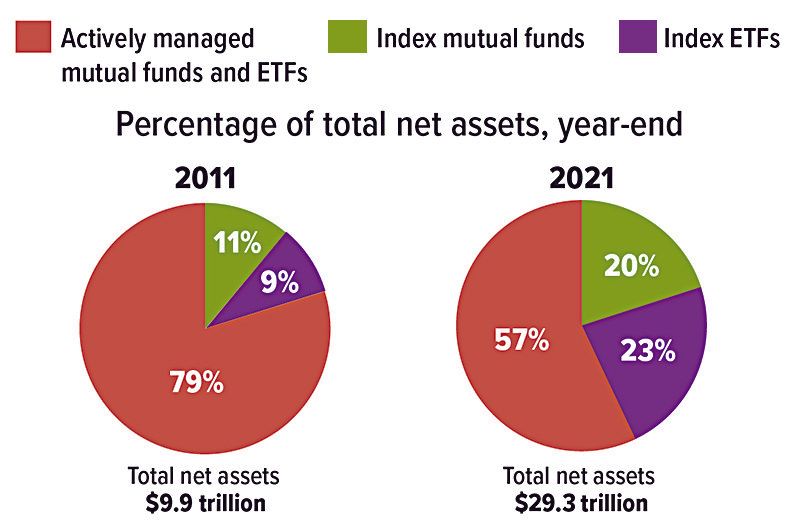
Index funds, which try to match the performance of a particular market index, have drawn increasing interest from investors, but traditional actively managed funds still hold more assets (see chart).
There is ongoing discussion in the financial media about which approach is most effective, but there may be good reasons to hold both in a well-diversified portfolio. Here are some pros and cons to consider.
A Simple Approach
Index funds typically hold the same securities in the same proportions as the index the fund is tracking (or in some cases a representative selection of securities). After assembling the fund, the fund manager generally makes adjustments only as necessary to track the index, so these funds are called passively managed.
The primary appeal is cost-efficient simplicity. Because index funds have less managerial involvement, fees are often lower than they are for actively managed funds. Index funds may also buy and sell assets less frequently, and lower turnover can help reduce capital gains distributions, which could be important when funds are held in taxable accounts.
However, this simplicity can also be a negative. Many well-known indexes commonly tracked by index funds are broad based and weighted by market capitalization, a company's value based on the number of outstanding shares multiplied by share prices. Some are price-weighted, meaning the price per share determines the weighting of the security. In either case, index investing may place heavy emphasis on a relatively small number of large companies in the index. And an index fund holds securities in the index regardless of the potential performance of an individual company.
A Decade of Growth
Index funds more than doubled their share of the fund market from 2011 to 2021.
Hands-On Strategies
Active fund managers strive to outperform benchmarks by hand-picking securities based on research and a defined investment strategy. Thus, actively managed funds offer the potential to outperform the broader market, although historically most of them have not.
According to investment analyst Morningstar, 45% of active funds outperformed the average comparable index fund in 2021, a slight drop from 49% in 2020. Both of these years were relatively successful for active funds, possibly because active managers were able to respond to rapidly changing market conditions during and after the pandemic. Over the 10-year period ending in December 2021, only 26% of active funds outperformed the average of their passive counterparts. However, performance varied widely for different underlying investments.(1)
An actively managed fund may be more diversified than an index fund holding stocks in the same asset category, because the manager can choose to weight the securities to meet the fund's objective rather than following the market-capitalization or price-weighted structure of an index. Diversification is a method used to help manage investment risk; it does not guarantee a profit or protect against investment loss.
Active managers also have more flexibility and may use a variety of trading strategies to help manage risks. For these reasons, some actively managed funds might offer defensive benefits when markets are falling, and they may be able to take advantage of specific market movements that might not be captured in an index fund.
Passive and active funds each have potential strengths and weaknesses, and there is no guarantee that any investing strategy will be successful. But holding both types of funds in your portfolio may provide a helpful balance.
The return and principal value of mutual funds and exchange-traded funds (ETFs) fluctuate with changes in market conditions. Shares, when sold, may be worth more or less than their original cost. The performance of an unmanaged index is not indicative of the performance of any specific security. Individuals cannot invest directly in an index. Past performance does not guarantee future results. Actual results will vary.
Mutual funds and ETFs are sold by prospectus. Please consider the investment objectives, risks, charges, and expenses carefully before investing. The prospectus, which contains this and other information about the investment company, can be obtained from your financial professional. Be sure to read the prospectus carefully before deciding whether to invest.
(1) Morningstar, February 2022
All Securities Through Money Concepts Capital Corp., Member FINRA / SIPC
11440 North Jog Road, Palm Beach Gardens, FL 33418 Phone: 561.472.2000
Copyright 2010 Money Concepts International Inc.
Investments are not FDIC or NCUA Insured
May Lose Value - No Bank or Credit Union Guarantee
This communication is strictly intended for individuals residing in the state(s) of MI. No offers may be made or accepted from any resident outside the specific states referenced.
Prepared by Broadridge Advisor Solutions Copyright 2020.