Retirees: Here's One Financial Move for Three Different Objectives

As fall transitions to winter, many retirees turn their thoughts to certain specific year-end objectives: supporting favorite charities, taking a required minimum distribution (RMD), and preparing for tax season.
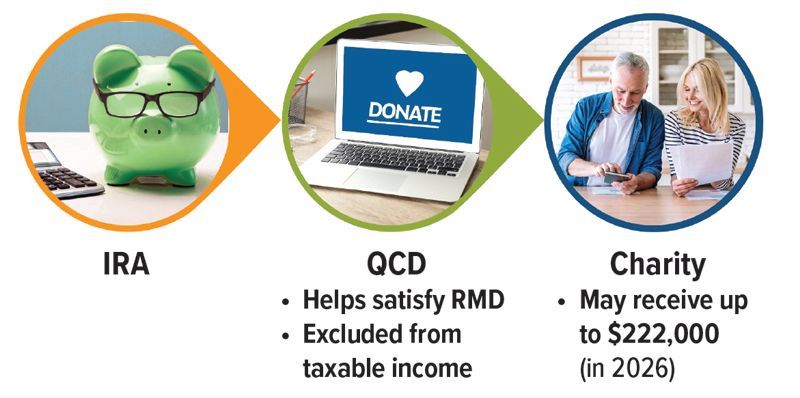
If you find yourself among this group, consider that a qualified charitable distribution (QCD) can help you tackle all three objectives at once.
Support your favorite charities
A QCD allows you to donate money directly from your traditional IRA to an eligible 501(c)(3) public charity.
If you're age 70½ or older, you can use a QCD to donate up to $111,000 in 2026. If you're married and your spouse also meets the age requirement, each of you may make a QCD from your own IRA, potentially doubling the donation. This high annual dollar limit allows you to build into your overall financial strategy a plan for providing strong support to the charities of your choice.
A few caveats, however: QCDs can be made only from eligible IRAs (generally, traditional IRAs other than SEP and SIMPLE IRAs), and the recipient must be an eligible public charity. Distributions to private foundations, donor-advised funds, and certain supporting organizations don't qualify. In addition, a QCD must be made directly from your IRA to the organization; you can't take a distribution, write a personal check, and claim it as a QCD.
Help manage your RMDs
Once you reach a certain age (73 or 75, depending on year of birth), you must begin taking RMDs annually from traditional IRAs.* The required amount is typically calculated by dividing the value of your IRA as of December 31 of the previous year by a life expectancy factor determined by the IRS. If you have multiple IRAs, an RMD must be calculated separately for each one. The total amount can then be taken from one or a combination of different IRAs.
How do QCDs fit into this equation? Quite simply: QCDs can be used to satisfy your annual RMD. For example, if your RMD for 2026 is $25,000, you can instruct the IRA custodian to direct all or part of the amount to an eligible charity through a QCD.
A word of caution, though: You can't take your RMD first and later decide to treat those dollars as a QCD. Under the IRS "first-dollars-out" rule, the first distributions you receive each year are applied toward satisfying your RMD. Once you've taken the money, you can't retroactively convert it into a QCD.
Benefits of a Qualified Charitable Distribution
Prepare for tax season
A key point about RMDs is that the tax-deferred portion of the distribution is generally subject to ordinary income taxes. Depending on the amount of the RMD, it could potentially push you into a higher tax bracket, render Social Security benefits taxable, and result in higher Medicare premiums. In addition, failure to take an RMD can result in a substantial tax penalty of 25% of the amount not taken (10%, if corrected in a timely manner).
One of the biggest advantages of a QCD is that the amount is excluded from your taxable income, which means it can meet your RMD requirement while generally not affecting your tax situation (or Medicare premiums).
In addition, a QCD is treated as coming first from the taxable portion of your IRA, even if you've also made nondeductible contributions over the years. By contrast, RMD amounts distributed directly to you are subject to the pro-rata rule, which states that you must receive a proportional share of both taxable and nontaxable amounts.
Because the distribution is excluded from your taxable income, you can't also claim it as a charitable deduction for federal tax purposes.
One move, three potential benefits
As you think about your year-end financial objectives, consider that a QCD may be an effective way to support a favorite charity, satisfy your annual RMD, and help manage your tax bill. However, also bear in mind that not all charitable organizations are able to use all possible gifts. It is prudent to check first. Before taking any action, be sure to consult your tax professional.
*Certain employer plan accounts are also subject to RMDs; however, you cannot make QCDs from employer plans. RMDs are not required from Roth accounts.
All Securities Through Money Concepts Capital Corp., Member FINRA / SIPC
11440 North Jog Road, Palm Beach Gardens, FL 33418 Phone: 561.472.2000
Copyright 2010 Money Concepts International Inc.
Investments are not FDIC or NCUA Insured
May Lose Value - No Bank or Credit Union Guarantee
This communication is strictly intended for individuals residing in the state(s) of MI. No offers may be made or accepted from any resident outside the specific states referenced.
Prepared by Broadridge Advisor Solutions Copyright 2020.